
Return on Sponsorship (RoS): the one number that works on every IPL sponsorship deal
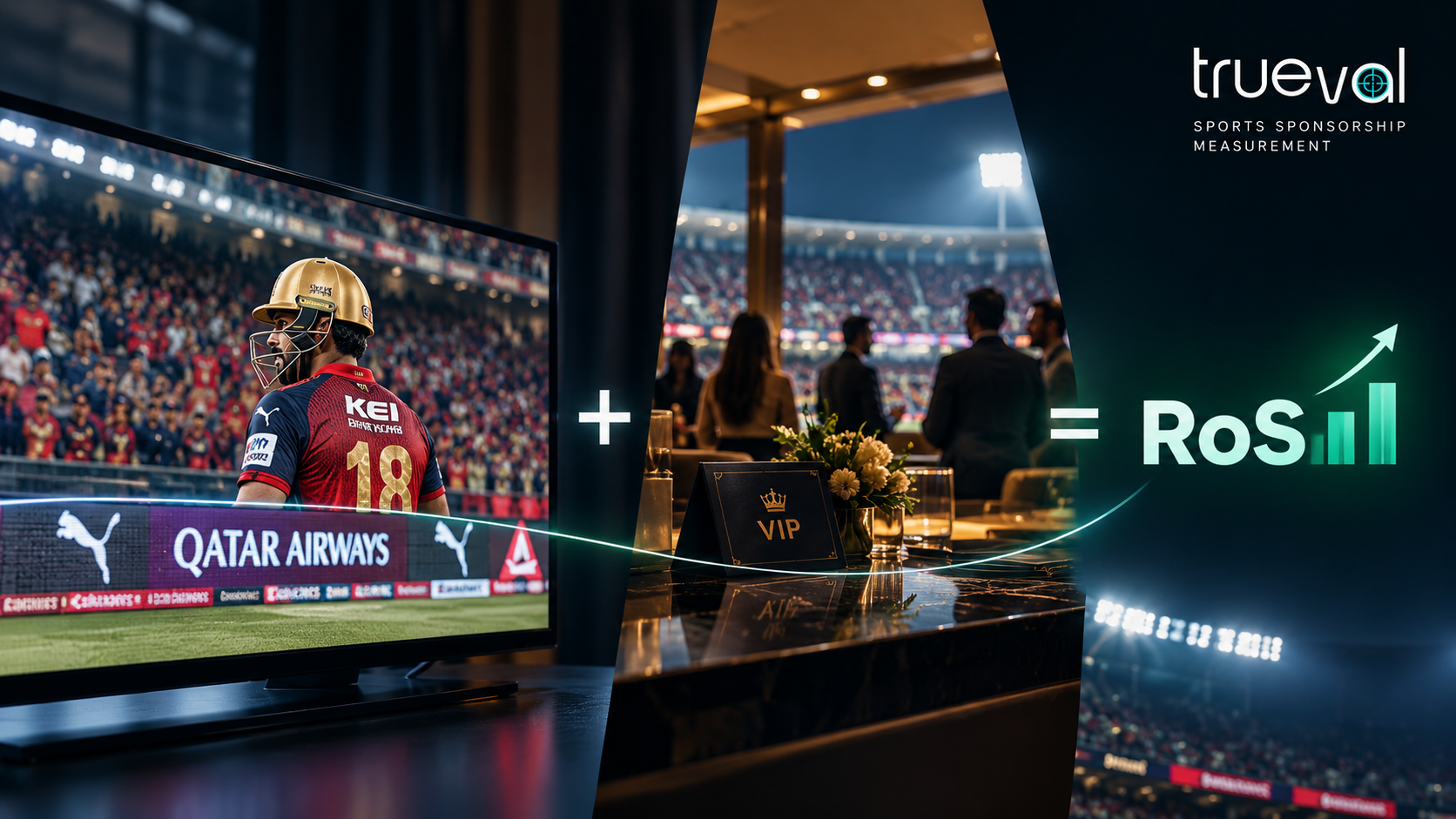
We've sold a lot of IPL sponsorships over eighteen years - Jersey positions. Perimeter boards. Associate deals. Team partnerships where the brand barely appeared on camera at all and bought access instead.
Different deals, different money, different reasons for buying. And at the end of every season, something I could never quite explain to a client. The reports came back wildly unequal.
Jersey brands got a single number without any reasoning or measurement or even proof with it. And the brand whose association was mostly off camera, the player days, the tickets, the hospitality box, the co-branded content, got nothing.
Nobody had measured any of it, because nobody had built a way to.
So a marketing head sitting with three IPL associations opportunities had reports that couldn't be compared with each other, and a final deal that was never measured at all.
You can't buy media like that. But you did!
That's the problem Return on Sponsorship was built to solve.
What it actually is
Return on Sponsorship is ROI for the whole deal, not just the logo - basically everything the deal actually delivered, on screen and off it, set against what you paid for it. That's it.
 Measured Screen Value + Non-Screen Deliverable Value
------------------------------
  What You Actually Paid

= Return on Sponsorship
It isn't a clever metric, it's division, the same division every other line of your marketing budget already gets. What's strange is how rarely anyone does it in sponsorship, and how much has to be true before the division means anything at all.
What did my logo actually do on screen?
Most reports count screen time. That's not the same as measuring it.
Counting means adding up appearances and multiplying by a flat rate. Which means a logo filling the frame during a six is priced exactly the same as a blurred mark half-hidden behind a fielder at the edge of the picture.
Anyone who's watched a cricket match in their life knows those aren't the same thing.
See content credentials

A second is not a second. Two frames, same 10 seconds, different value.
At TrueVal we don't put a price on a second of screen time until we know four things about it.
How much of the screen did it hold, and where? There's a minimum size below which a logo doesn't count at all, not discounted, not counted. Above that line, a mark sitting near the centre of the frame is worth more than one clinging to the edge, and a logo holding still is worth more than one flying past on a camera pan.
Could a person actually read it? A sharp mark with good contrast against the shirt behind it is worth more than the same mark washed out, blurred in motion, or lost in a frame crowded with six other sponsors. This is the check almost nobody else runs, and it's often what separates two brands sitting in near-identical positions.
How long did it hold? One clean twelve-second hold is worth more than twelve scattered one-second flickers, because attention needs somewhere to land.
And was anyone watching? A second during the pre-match show and a second in the last over of a chase are not the same second. We attach the live audience to each one, and price it against what that exact moment would have cost you as ad spend.
Only then does it become rupees.
You don't need the full workings to use the number, though. Eleven separate checks sit behind those four questions, they come attached to every report we deliver, and if you want to watch a single second get built from start to finish, it's here: How a second is valued.
What matters here is the principle:
We're measuring what a person watching could actually see, notice & possibly remember, not what a AI Detection model could technically detect.
What about everything that never reached a camera?
This is the half nobody else touches, and for most IPL deals it's the bigger half. More than 80% of IPL 2026 sponsorships were non-logo sponsorships. So how did those brands work out what came back? Mostly they didn't. And the few who were diligent enough to measure it themselves had nothing to hold the answer against, because every brand builds its own format and no two numbers mean the same thing.
Eighty percent of the market, and no common way to price any of it.
An IPL association is rarely just a logo. Somewhere in the schedule there are usually player appearance days, shoots, a block of match tickets, hospitality, in-stadium branding and fan-zone activation, co-branded social and content rights, and often merchandise, presentation moments or category exclusivity. Every one of those is part of what the fee buys, and every one has a price you would need to spend if you had to buy it on its own. Not one of them shows up in a broadcast visibility report, for the simple reason that a broadcast visibility report is looking at the broadcast.
So we price them, item by item, against market references we show you. It's unglamorous work and it takes longer than the frame analysis does. It's also, more often than I expected when we started, the part that changes the answer.

The invisible half. Left half is barely measured - The right half is completely ignored.
So what did the whole thing return?
Put both halves together over what you paid and you finally have something you can act on. Say a brand puts ₹10 crore into a team association, with back of team jersey and a substantial deliverable schedule behind it. We measure the broadcast properly and it comes to ₹18 crore. We value the rest of the agreement and it comes to another ₹7 crore. Twenty-five crore returned on ten, which is 2.5x.
See content credentials

Look at the wrong report and you see 5x. Let's leave that conversation for another day!
Measure only the broadcast and you'd have walked into that renewal calling it 1.8x. More than a quarter of what the brand actually got would have been invisible to the only report it had. That isn't a rounding difference.
On a buying conversation, it's the gap between holding on to your RoS or lowering it.
Why this matters more than it sounds
Here's the part that surprised me. Once you're measuring both halves, every kind of IPL association becomes comparable, and not roughly either. A front-of-shirt deal is mostly screen with a deliverable tail. Ground branding is screen too, but in a different part of the telecast at a different rate. An associate sponsor might be barely on camera and almost entirely deliverables, and a team partner buying players and content sits somewhere in between. Four completely different things to buy, and one number that lets you line them up, rank them, and decide which ones to do again.
That was never possible with a visibility report, because a visibility report can only see the part that was visible. It isn't a flaw in anyone's product.
It's what happens when the tool was built to please the sponsor rather than to evaluate a deal.
What it won't tell you
It won't tell you whether anyone's opinion of your brand changed - just like CTR and views never could. RoS measures what you received against what you paid, and brand effect is a separate study, so anyone selling you one number for both is overselling. It isn't a market price either. It's the most defensible measurement available for what you got, built from rate benchmarks you can swap for your own negotiated rates whenever you like.
Before IPL 2027
The deals that matter are shaped months before the first ball, which means the useful question isn't whether last season went well. Everybody says yes to that one. The question is what each rupee returned, and which parts of it you would buy again.
We'll run Return on Sponsorship on any IPL association you already hold or are thinking about, and if you go on to buy your IPL 2027 sponsorship through our agency, Just About Sportz & Showbiz, the entire amount you paid us comes back to you as credit. Over the coming weeks I'll take each half of this apart properly: what detailed really means on the screen side, how we put a price on a player day, and where the standard reports quietly go wrong on both.
For now, go and look at our published sample report. Then hold it up against any sponsorship report you have seen before, whether it was yours, a client's, or one a property sent you. The gap is not in the quality of the analysis. It's in how much of the deal the other report never went near, and most people are surprised by how little that is.
That surprise is the whole argument.
Amit
Also published on LinkedIn
Join the conversation there.